Roasted Tomatillo Salsa with Preserved Lime

Newsletter
Subscribe at the bottom of this page for the Chic Eats roundup. It includes new and updated recipes along with a grab bag of unique content that was interesting enough to share around the dinner table.
Tomatillo Salsa
Purple tomatillos (pictured above) have a similar flavor to green. They're slightly less tart but the two are interchangeable in this recipe.
Pairing the sweet-tart notes of roasted tomatillos with spicy peppers and the floral complexity of preserved limes is a marriage made in the cosmos. My original intent was to make hot sauce, but then things evolved into this Roasted Tomatillo Salsa with Preserved Lime. While salsa may not be the star of the show, I like to think of this version as an understated diva thanks to the depth it brings to any meal.
Tomatillo salsa is foundational to many Mexican dishes and thousands of recipes exist. That said, there does seem to be a standard formula. The typical lineup includes tomatillos—roasted, boiled, or raw—along with cilantro, spicy peppers, alliums like onions or shallots, garlic, lime, salt, and optional vinegar. I'm not the first person to add preserved limes but was surprised that none of the 15+ cookbooks I referenced included them. I realize it's not traditional, but that has never stopped cooks from being creative. Preserved lime is a superb partner for tomatillos and arguably provides the defining characteristic of this salsa.
On that note, I must declare that preserved key limes are a larder superstar. I went Instagram official with my love here. While preserved Meyer lemons deserve all of the praise they receive, I'm constantly inspired to find dishes to showcase the beautiful flavor of preserved key limes. I've added them to coleslaw, mango sorbet, various salsas, and black bean soup, among others. The twenty minutes it takes to salt and jar the limes is repaid many times over. Patience and preservation are both powerful tools in the kitchen.

Around the Dinner Table
Jam Session
I fell down the tomatillo rabbit hole and discovered that they're rich in natural pectin. This may explain why roasted tomatillo salsa has a more substantial texture. The next logical step given all of that pectin was to look around for a tomatillo jam recipe. I'm thinking it could punch up a basic grilled cheese sandwich or add some acidity to a cheese plate. As a general rule of thumb, I try to combine fatty or rich ingredients with something acidic since that amplifies the flavors.
I bookmarked a tomatillo and lime jam as a starting point and also found jams that combined blueberries or blackberries with the tomatillos—sounded brilliant. Lime enhances the essence of blueberries, so a preserve that layers these ingredients with some acidity from the tomatillos makes sense to my mental palate. Hoping to give the sweeter side of things a try with my next tomatillo haul.
3 Tomatillo Tips
Sticky Business
As you remove the husks from the tomatillos, you'll notice a sticky residue on your fingers. This is a harmless part of the fruit's protective layer but should be washed off. My approach is to submerge the husked tomatillos in a large bowl of plain water and give them a good rub. Drain the water and repeat the process two more times. The cleaning water usually looks less "soapy" by the third rinse.
Size
From Nopalito to On Vegetables, most articles and cookbooks suggest selecting tomatillos that are smaller with the husks on—roughly the size of a golf ball.
Storage
I keep the husks on and refrigerate the tomatillos in a vented bag with a couple of paper towels to absorb moisture. The fruit will last weeks when stored this way.
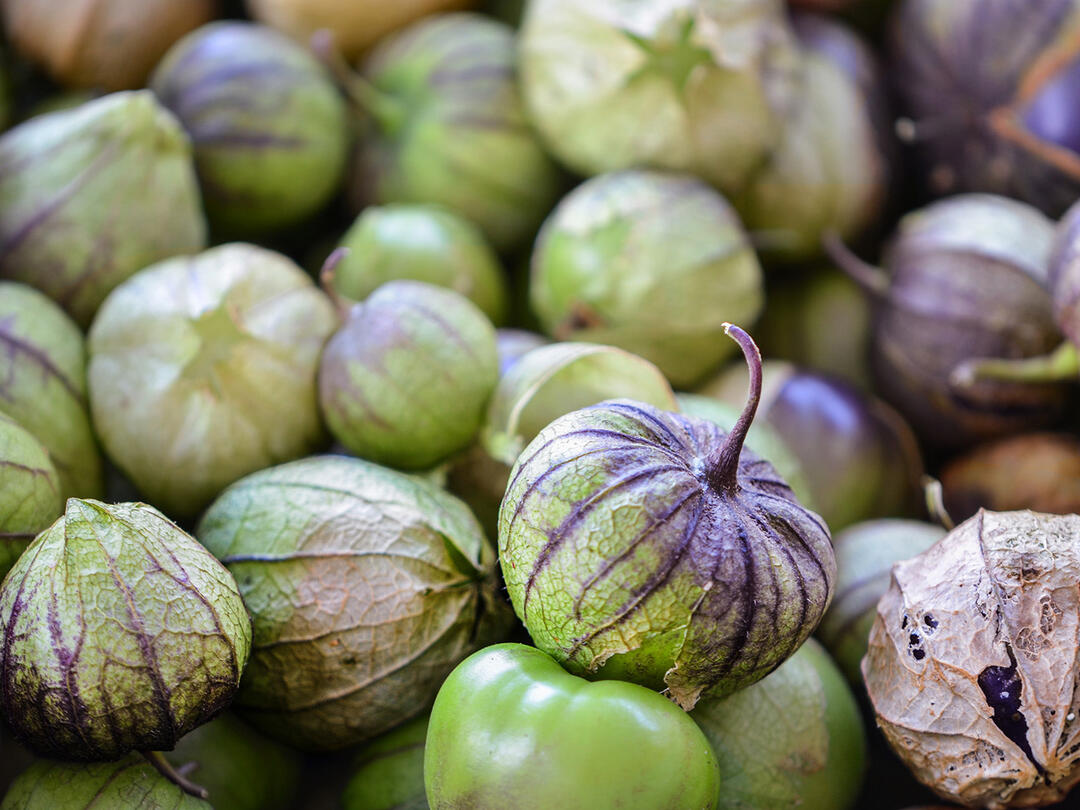
Tomatillos at the Santa Monica Farmers Market
Recipe Tips
The context for these tips is that I'm a spicy food lover and have a solid tolerance for heat.
Balance Is Created, Not Found
Roasting tomatillos and onions enhances their natural sugars, so the art and pleasure of making salsa verde is balancing that sweetness with acid and heat. Perhaps the photo above is salsa púrpura? Though most raw tomatillo salsa recipes don't call for apple cider vinegar, the extra acidity complements roasted ingredients beautifully. I'm a strong advocate for mixing acids—balancing citrus juice and vinegar—something I also mention in my Pizza Sauce recipe. They harmonize by playing the same tune at different volumes.
Mellow Out
I've found that vinegar and lime juice can mellow spicy peppers. The brief explainer is that capsaicin, the chemical that gives peppers a kick, leans to the alkaline side of the pH scale (4+ pH on a 0 to 14 scale). On the other hand, lime juice and vinegar are decidedly acidic with a pH of around 2. The vinegar neutralizes the capsaicin which takes the edge off the heat.
To keep the tomatillo salsa from falling flat, I use a mix of jalapeño and punchy serrano peppers. Taste your peppers before adding them to the salsa to gauge how much of the ribs or seeds you want to add. Once the salsa has time to meld (preferably overnight), it's easy to increase the heat if you aren't happy with the spice level.
Salsa Prepper
Tomatillos aren't always available at the farmers market so I roast then freeze several pounds with onion and garlic. If possible, vacuum sealing helps the ingredients last for quite a while without developing flavor issues. The prepared salsa also freezes fine though the texture can degrade a touch over time. For recipes where the salsa is being mixed into a sauce, the texture isn't as important.
Farmers | Artisans
I make an effort to source my food from California artisans with a special focus on the Santa Monica Farmers Market. Below is a list of the folks who contributed to this dish.
- Flora Bella Farm // Tomatillos
- Coleman Family Farms // Tomatillos
- Finley Farms // Cilantro, Onions
- JJ's Lone Daughter Ranch // Limes
- Polito Family Farms // Limes
- Garcia Organic Farm // Limes
- Windrose Farm // Garlic, Tomatillos
- Milliken Family Farm // Garlic
- Belyik Farms // Peppers
- Tutti Frutti Farms // Peppers
- Katz Farm // Apple Cider Vinegar

Tools
- Cuisinart 7-cup Food Processor - A workhorse in my kitchen that I've had for over a decade. I run the bowl and blade through the dishwasher 1/3 of the time and everything has held up very well.
- My Favorite Cooking Tools spotlights the kitchen equipment I’ve owned and used for years from bread baking to coffee brewing.
Ingredients (Makes a little more than a quart of salsa which is a large deli container.)
Roasting
- 907 grams (2 pounds) tomatillos with husks removed
- 230 grams (8 ounces) red or yellow onion measured after prep, medium Note: I recommend yellow onion if you're using green tomatillos. The red onion can muddy the color of the final product when mixed with green. For the purple tomatillos I used red onion. It's true, onions have different flavor profiles but I've swapped them around over the years and always enjoyed the outcome.
- 4 to 6 garlic cloves (30 grams/1 ounce) separated and with the skin left on
- 2 1/2 tablespoons olive oil
Salsa
The fun with this salsa is you can add ingredients, process, then taste. It's easy to make adjustments on the fly to suit your palate.
- 780 grams (11 1/2 ounces) roasted tomatillos from the roasting section above
- 4 roasted garlic cloves (20 grams), skin removed from the roasting section above
- 5 ounces (140 grams) roasted red onion from the roasting section above
- 1 rinsed preserved key lime rind (22 grams), plus some of the pulp
- 100 grams (3 to 4) jalapeños, sliced Note: See "Mellow Out" under Recipe Tips.
- 30 to 50 grams (1 to 2) serrano peppers, sliced
- 4 grams (generous 1/4 cup) cilantro leaves with soft stems
- 4 grams (1 generous teaspoon) flaky sea salt plus more for adjustments
- 19 grams (1 tablespoon + 1 teaspoon) apple cider vinegar plus more for adjustments
- A squeeze or two of fresh lime juice plus more for adjustments
Instructions
Roast
- Adjust the oven racks to the lowest position and heat to 500°F/260°C.
- Prick the tomatillos with a paring knife to prevent them from bursting in the high heat.
- Line a baking sheet with foil. Keeping the vegetables in separate sections of the tray, add the tomatillos, chopped onion, and garlic. Toss the vegetables with 2 1/2 tablespoons of olive oil and 1 teaspoon of flaky sea salt. Do your best to spread everything out in an even layer. Note: I like to keep the onions, garlic, and tomatillos separate so I can adjust the amount of each that's used. Any leftovers can easily be added to other dishes.
- Place the baking sheet on the lower rack and roast until the tomatillos start to release their juices and char, stirring the vegetables once. This should take about 10 to 15 minutes.
- Transfer the garlic and onions to a small bowl. Then transfer the tomatillos and all of their juices into a second bowl, using the foil to help guide things along.
Note: At this point, you can freeze the vegetables for a future date. I usually leave them in the refrigerator overnight to chill before freezing.
Puree
- Combine all of the ingredients listed under "Salsa" in a food processor and puree until homogeneous.
- Taste and adjust as needed. I aim for the preserved lime to be noticeable but not dominant, with the vinegar and lime juice playing supporting roles. If the salsa tastes too sweet and the flavor falls flat, that's often an indication that there isn't enough acid. In small amounts, increase the lime juice and apple cider vinegar until everything pops (it sometimes needs a little more salt, too). These are minor adjustments that depend on your tomatillos and preference. I usually make the final adjustments after the flavors have had time to meld overnight.
Storage
The salsa keeps well in the refrigerator for several days or can be frozen.
Newsletter
Subscribe at the bottom of this page for the Chic Eats roundup. It includes new and updated recipes along with a grab bag of unique content that was interesting enough to share around the dinner table.